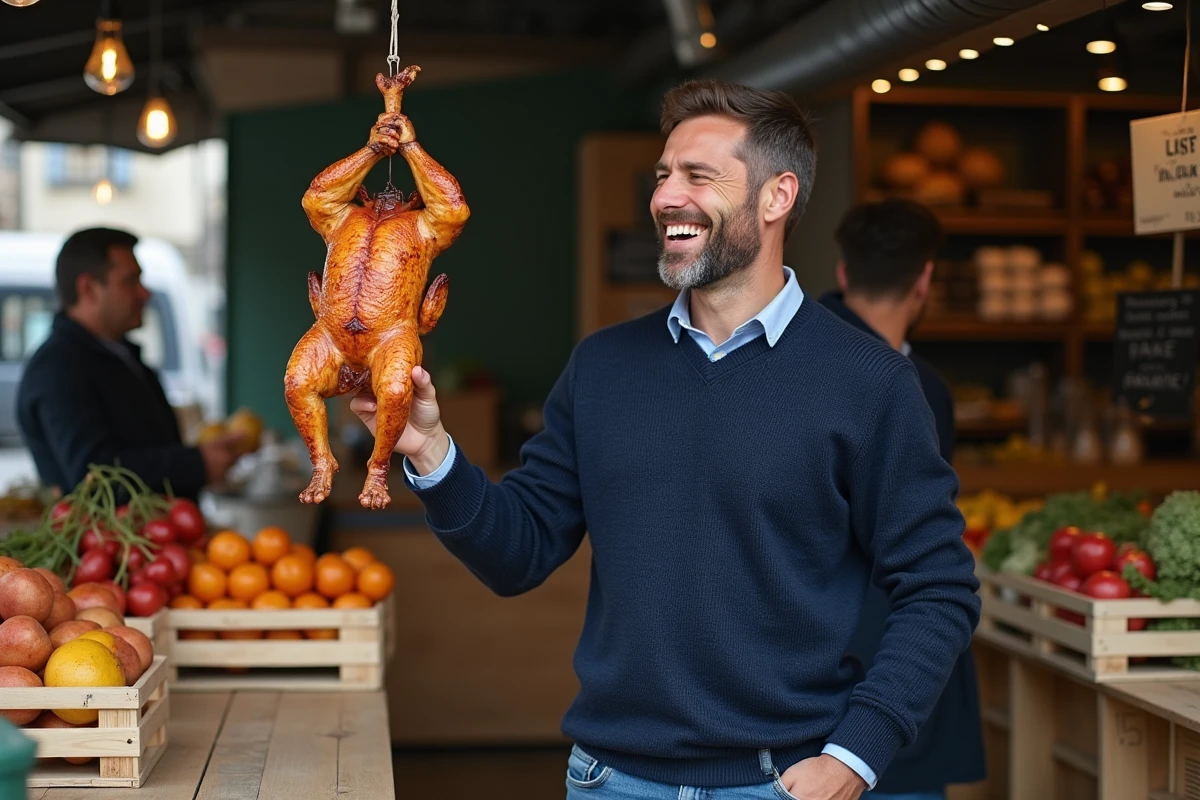
Between 1808 and 1907, certain familiar terms in French evolved in unexpected ways. Apparently innocuous words took on surprising meanings in slang, often with no direct link to their original sense. These twists, far from being marginal, became firmly entrenched in everyday usage and testify to sustained linguistic creativity.
The use of the word “poulet” in slang illustrates this trend of vocabulary reinvention. The meanings associated with it vary according to the times and contexts, revealing a complex network of social, police, and popular influences.
French slang between 1808 and 1907: a mirror of a changing society
The French language continues to reinvent itself, faithfully reflecting the upheavals that traverse society. Between 1808 and 1907, Parisian slang abounds with new terms, mirroring a capital in full transformation. On the Île de la Cité, life revolves around markets and administrations. The old poultry market, once a nerve center, gives way to the police prefecture, a transition initiated under Napoleon Bonaparte and realized with Jules Ferry.
This geographical shift is not just an urban fact: it leaves its mark on the language. When the police settle in the walls of the old market, Parisians see an opportunity to nickname these new neighbors with a biting moniker. “Poulet” then becomes the nickname that sticks to the agents, born from a comical proximity between the poultry cages and the established order.
This popular play on words is far from anecdotal. As early as 1899, slang dictionaries record this designation. Slang, never short of inspiration, invests every corner of the city to invent its vocabulary, shaping a particular link with each profession, each place. This dynamic, far from being marginal, anchors the term “poulet” in collective memory.
The expressions of poulet in slang go beyond mere mockery: they embody the remarkable ability of language to appropriate the evolutions of society. Their persistence in oral and written tradition testifies to a creativity made of irony, resistance, and winks. French slang thus asserts itself as the living witness of major social changes.
Why did the word “poulet” become established in popular language?
The designation “poulet” for police officer is not a matter of chance. At the end of the 19th century, the police prefecture takes its quarters on the Île de la Cité, right where, a few years earlier, feathers and clucking were exchanged at the poultry market. This atypical proximity almost naturally gives rise to a nickname that quickly establishes itself in the streets and even in the press.
This is not just a geographical story: popular language loves animal imagery and biting nicknames. Assigning a term from the poultry world to police officers is a way of using humor while highlighting their increased presence in the city. From then on, “poulet” establishes itself in French slang and becomes firmly entrenched, echoed by all circles.
Behind this choice lies more than just a clever turn of phrase. The capital’s inhabitants, by naming the police in this way, appropriate the police presence and desacralize it. This expression, stemming from an urban decision by Jules Ferry but rooted in a city policy launched under Napoleon Bonaparte, transcends decades without aging a bit.
To shed light on this phenomenon, here are the factors that favored the adoption of the term “poulet”:
- The configuration of the city influences the emergence of new words.
- Each social change is accompanied by a renewal of slang.
- The figure of the “poulet” asserts itself, oscillating between teasing and keen observation of everyday life.

Surprising expressions around poulet: origins, uses, and unknown legacies
The popular language is full of expressions where the poulet, hen, and rooster take on unexpected roles. As early as the 16th century, “receiving a poulet” means receiving a promissory note. Racine, Molière, Alphonse Daudet, or Mme de Sévigné use this word in their letters or works, inspired by the folded form of the message, evoking the wing of a bird. Furetière, a famous lexicographer, details it: the folded note resembles the silhouette of a hen, hence the image.
The vocabulary is enriched with nuances. Sometimes mocking, often tender, it traverses the centuries: “poule mouillée” refers to fear, “poule de luxe” evokes the world of refined prostitution, and “comme un coq en pâte” refers to a cozy comfort. The expression “fils de la poule blanche,” noted by Mathurin Régnier and Juvenal, suggests extraordinary, almost insolent luck.
Proverbs and fables extend this bestiary. With “the hen that lays golden eggs,” La Fontaine, inspired by Aesop, denounces the greed that leads to losing everything. “When hens have teeth” is used to dismiss something impossible, while “having goosebumps” conveys shivers or fear. These images traverse the ages, shaping the language and its inventiveness.
To better grasp the diversity of expressions around poulet, here are some common examples:
- Hen that found a knife: manifest embarrassment in the face of novelty
- Mother hen: attentive and protective mother
- Chicken heart: marked nervousness or fear
From the works of Molière to Marguerite de Valois, through Suetonius, these expressions are passed down, metamorphose, and invite themselves into everyday life. The French language, always in motion, draws from the familiar world of the barnyard to shape a repertoire of idiomatic expressions where prosaic reality and popular imagination intertwine. After that, it’s hard to encounter a poulet, or a police officer, without hearing the echoes of a whole slice of history and collective irony.