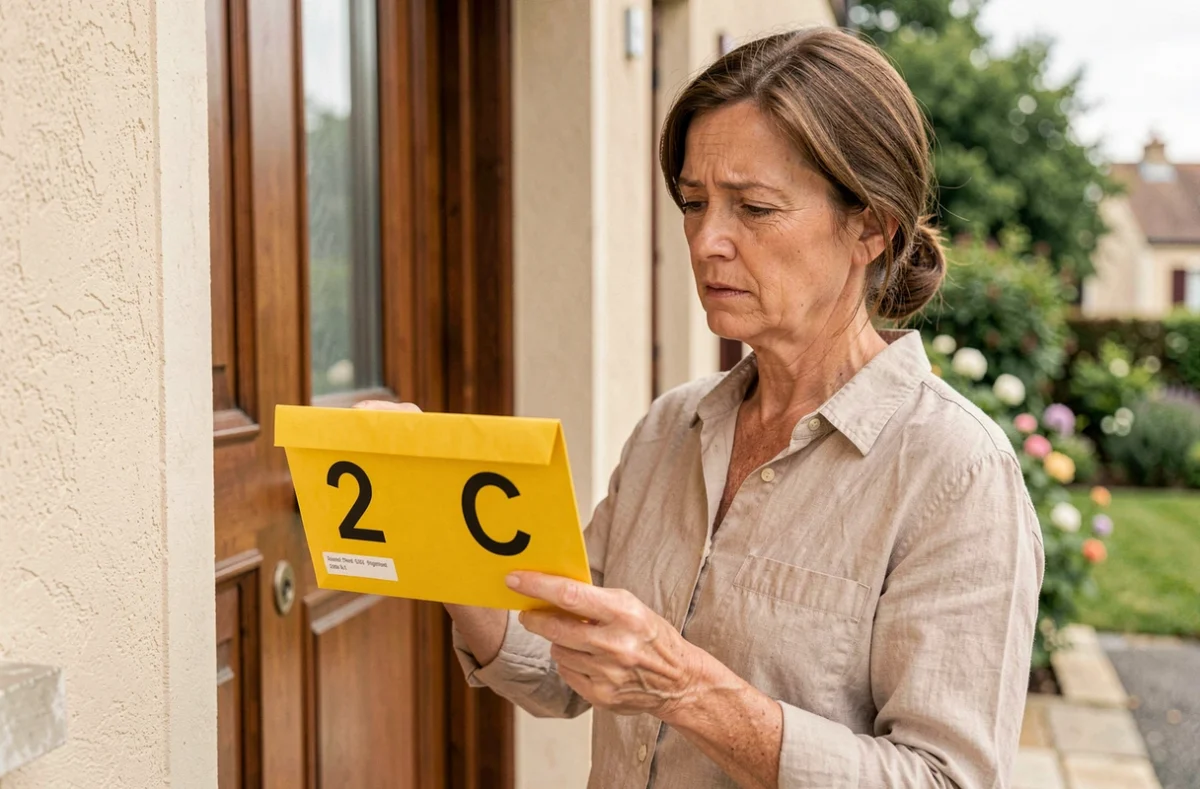
A notice mentioning a number starting with “2C” often generates immediate concern. Many people seek to know whether this registered letter comes from their bank, a collection agency, or an administration. The prefix 2C, however, reveals almost nothing about the identity of the sender. Understanding what this code actually encodes, and what it does not say, helps avoid hasty interpretations.
What the 2C prefix encodes in the postal tracking reference
The tracking number of a registered letter consists of several segments. The prefix (2C, 2D, 1A, RW, etc.) identifies the type of postal medium used, not the nature of the mail or its sender.
The 2C code corresponds to a format of registered mail on A4 paper, commonly used by professionals with postage contracts with La Poste. This format allows for bulk printing, which explains its massive use by companies, banks, insurers, landlords, and administrations. An individual who goes to the counter to send a registered letter will generally receive a different prefix.
The 2C prefix does not allow for the identification of the sender or the drop-off location. It is a technical element of the tracking chain, not a code assigned to a specific sector. To better understand the meaning of a 2C registered letter, one must first accept this limitation: the number alone does not speak.

Online tracking of the 2C registered letter: what information is actually accessible
La Poste provides an online tracking tool where one can enter the complete number found on the notice. The information returned exclusively concerns the postal journey of the item:
- The date and time of acceptance by La Poste
- The stages of delivery (sorting, transport, arrival at the distribution office)
- The delivery status (presented, pending, delivered, returned to sender)
The identity of the sender does not appear in the online tracking. Even with the complete number, the recipient cannot know who sent the mail until they open it or pick it up. This confidentiality is not a bug in the system: it stems from the postal framework itself.
Some notices may sometimes include the name or logo of the sender, but this is at the sender’s discretion. La Poste does not require this mention. In most cases, the notice only bears the tracking number and the pickup information.
2C registered letter and bank: why the association is common but misleading
The search “2C registered letter bank” is very common. It is based on a simple reasoning: banks heavily use registered mail for certain contractual notifications, and the 2C format is the most common among professional senders.
In reality, the same 2C medium can be used by very different senders: a landlord giving notice, an insurer terminating a contract, a collection agency, a mutual insurance company, a court, or a local authority. No technical distinction separates a 2C registered letter sent by a bank from a 2C registered letter sent by a bailiff.
Indirect clues before pickup
Some elements can sometimes help reduce uncertainty, though they never completely eliminate it:
- The personal context: an ongoing loan renegotiation, a dispute with an insurer, or an awaiting administrative procedure can guide the probability
- The originating office mentioned on the notice (when legible): a postal code far from your home may indicate a professional processing center, not necessarily the location of the sender
- The possible presence of a company name on the envelope or notice, left to the sender’s discretion
These clues remain fragile. Only opening the mail confirms the identity of the sender.
To pick up or ignore a 2C registered letter: concrete consequences
A registered letter not picked up within the retention period (generally about fifteen days after the first delivery attempt) is returned to the sender. This return does not eliminate the legal effects of the mail.
A registered letter that is not claimed is deemed presented on the date of the first delivery attempt. If the mail contained a formal notice, a termination notice, or a legal notification, the deadlines run despite the absence of pickup. Ignoring a registered letter out of fear of its content does not protect the recipient.
On the other hand, picking up the item allows one to know its content, check any response deadlines, and prepare an action if necessary. The pickup can be done at the post office indicated on the notice, with an ID and the notice itself.

Distinguishing a 2C registered letter from other postal prefixes
The 2C prefix is not the only one in circulation. Here are the useful distinctions:
| Prefix | Type of medium | Common usage |
|---|---|---|
| 2C | Professional A4 registered letter | Companies, banks, administrations |
| 2D | A4 registered letter (variant) | Similar to 2C, different contract range |
| 1A / 1B | Counter registered letter | Individuals, small structures |
| RW / RZ | International registered letter | Shipments from or to abroad |
| SD | LRSD bundle (new format) | New La Poste standard, Smart Data |
The prefix indicates the medium and the processing circuit, never the content. A 1A registered letter sent by an individual can contain a formal notice just as binding as a 2C registered letter issued by a bank.
The only certainty when faced with a notice mentioning a number in 2C is to pick it up to read its content. No online tool, no prefix, and no external clue can replace the opening of the item.