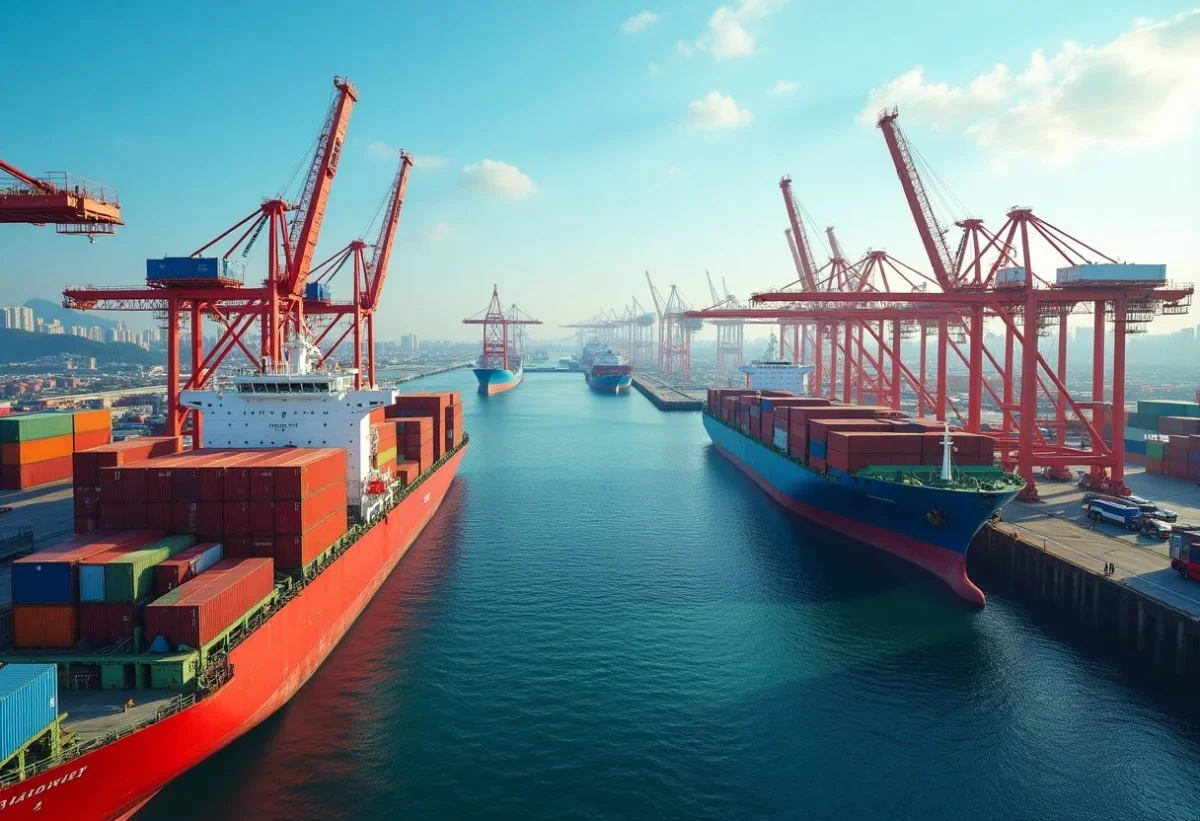
Faced with a world in constant flux, where distances seem to shrink as technologies evolve, international transport plays a crucial role in maintaining and evolving economic and cultural relations on a global scale. International exchanges, driven by a constantly expanding demand, require complex infrastructures and innovative solutions.
The historical evolution of international transport
Transport beyond national borders is not a recent phenomenon. Over the centuries, it has undergone radical transformations that have shaped our modern world.
- During the age of great discoveries, sailing ships, such as those of Christopher Columbus and Vasco da Gama, opened new maritime routes, connecting entire continents and initiating an unprecedented era of global trade. Then, with the industrial revolution, the advent of steam revolutionized rail and maritime transport, making exchanges faster and more accessible.
- In the 20th century, the introduction of aviation marked a new milestone by significantly reducing travel time between continents, making the world more accessible.
- Today, we live in the digital age, where information and communication technologies optimize logistics management and the traceability of goods.
Transport modes: diversity and adaptability
To meet the varied needs of international exchanges, several modes of transport are used, each offering distinct characteristics and advantages.
- Maritime transport: Ideal for bulky goods, it remains the most economical mode over long distances.
- Modern container ships can carry thousands of standardized containers, thus facilitating mass international trade.
- The relative slowness of maritime transport is offset by reduced costs.
- Aerial transport: Valued for its speed, it is essential for perishable goods and high-value merchandise.
- Although costly, it allows for quick delivery, which is essential for meeting tight deadlines.
- Direct and frequent air links between major global cities enhance its utility.
- Road transport: Essential for short-distance transport, particularly for final distribution.
- The flexibility of road transport allows for efficient door-to-door delivery, a major asset in logistics networks.
- Rail transport: It combines capacity and speed, perfect for continental journeys.
- It is particularly effective in Europe and Asia, where infrastructures are well developed.
The challenges of international transport
Despite technological advancements, international transport faces several major challenges, related not only to logistics but also to economic, political, and environmental factors.
Firstly, environmental issues are becoming unavoidable. The ecological impact of goods transport, particularly greenhouse gas emissions, raises serious concerns. The need to develop more sustainable and eco-friendly solutions is urgent.
Next, the complexity of customs regulations and trade policies between different countries can pose a barrier to transport efficiency. One must constantly navigate through a maze of laws and regulations that vary from country to country.
Finally, the security of goods in transit represents a crucial issue. The threat of maritime piracy in certain regions, as well as the theft or loss of goods, necessitates enhanced security measures.
The future of international transport
As the world continues to change, international transport is constantly reinventing itself to adapt to new economic and technological realities.
The development of information and communication technologies promises to transform international logistics. Blockchain, for example, could ensure better traceability of goods, while artificial intelligence could optimize transport routes.
Moreover, advancements in autonomous vehicles and drones could revolutionize the way goods are delivered.
The growing pressure to reduce carbon footprints is also leading to the emergence of greener logistics solutions. Biofuels, renewable energies, and innovations in propulsion are at the heart of the concerns of industry players.