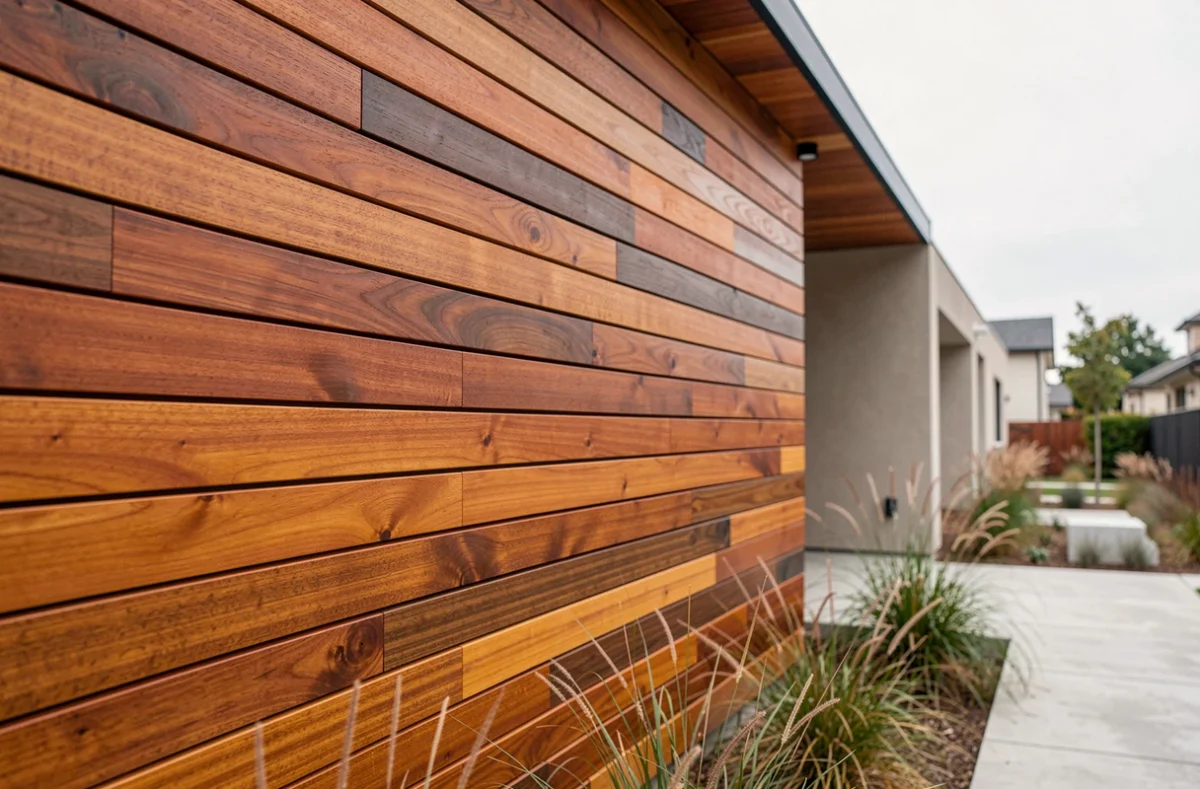
Padauk is an African exotic wood whose bright red hue draws attention to contemporary facades. Its use in exterior cladding raises questions that go beyond mere aesthetics: traceability regulated by CITES since 2023, fire compliance of the complete facade system, uneven graying depending on exposure. These are all technical parameters that deserve careful examination before proceeding.
Padauk and CITES Regulation: What the Annex II Listing Changes for Cladding
Since February 23, 2023, padauk has been listed in Annex II of CITES. This listing does not prohibit trade, but it requires traceability documents and export permits for the affected lots. For a buyer of cladding boards, the direct consequence is simple: a generic mention of “sustainable exotic wood” on a product sheet is no longer sufficient.
It is necessary to verify the precise origin of the wood, the existence of a valid CITES permit, and the supplier’s chain of control. A reputable distributor, such as padauk cladding on Batiwiz, displays this information or provides it upon request. The absence of these documents exposes the buyer to legal risk and makes it impossible to guarantee the origin forest management.
This regulatory constraint also affects supply times. Administrative formalities can sometimes lengthen the availability of lots, a factor to anticipate in order not to block a facade project.
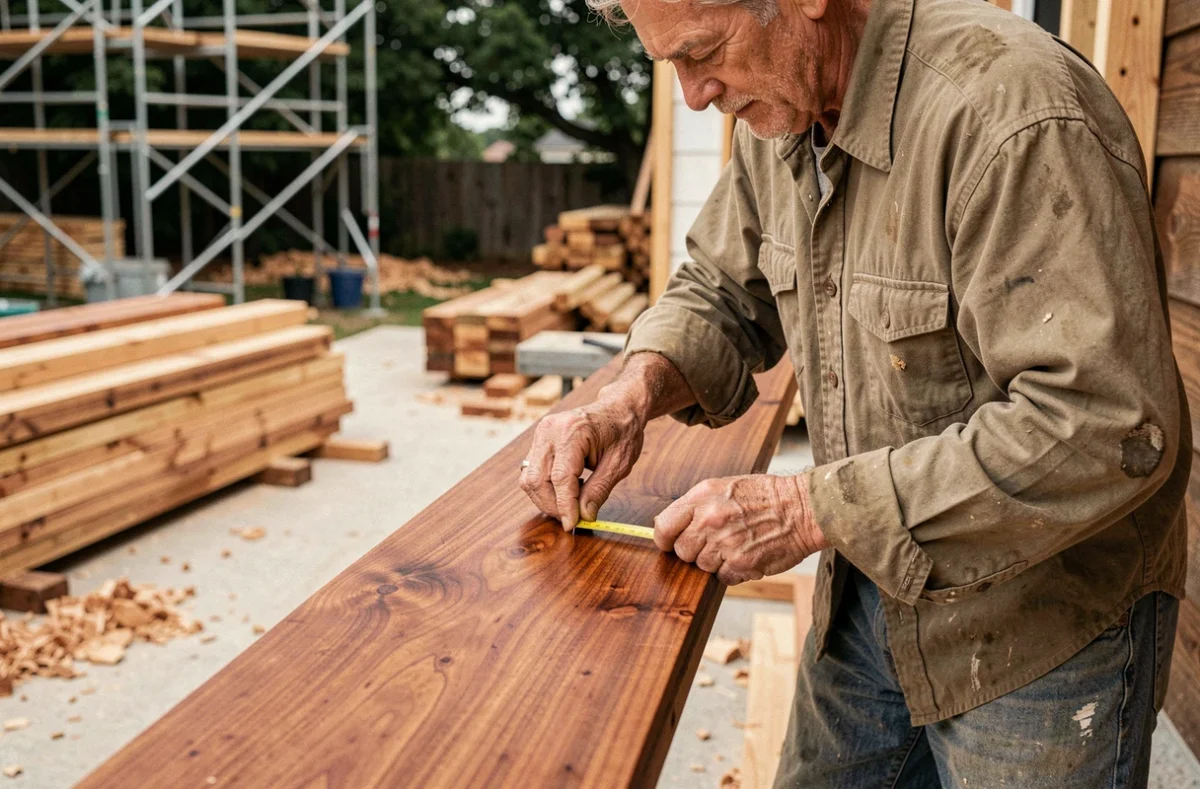
Fire Reaction of Padauk Cladding: The System Matters More Than the Species
The fire resistance of cladding does not solely depend on the chosen wood. It is the entire facade system that determines fire compliance: boards, fasteners, framework, rain barrier, insulation, and ventilated air gap. The NF DTU 41.2 regulates the implementation of wood cladding and refers to fire reaction requirements expressed in Euroclasses.
The old French classes (M0, M1, etc.) are no longer sufficient to justify the performance of cladding. European standards require a classification report that takes into account the actual installation conditions. In practice, this means that padauk classified as having high natural durability may pose problems if the rain barrier or insulation behind it is not suitable.
Building Height and Variable Constraints
The fire reaction requirements vary according to the height and use of the building. Padauk cladding installed on a single-story house does not fall under the same obligations as a multi-family building with three floors. Before validating the choice of species, it is necessary to consult the rules applicable to the specific configuration of the project, or even request a specific technical assessment.
Graying of Padauk in Exterior Cladding: A Phenomenon to Anticipate
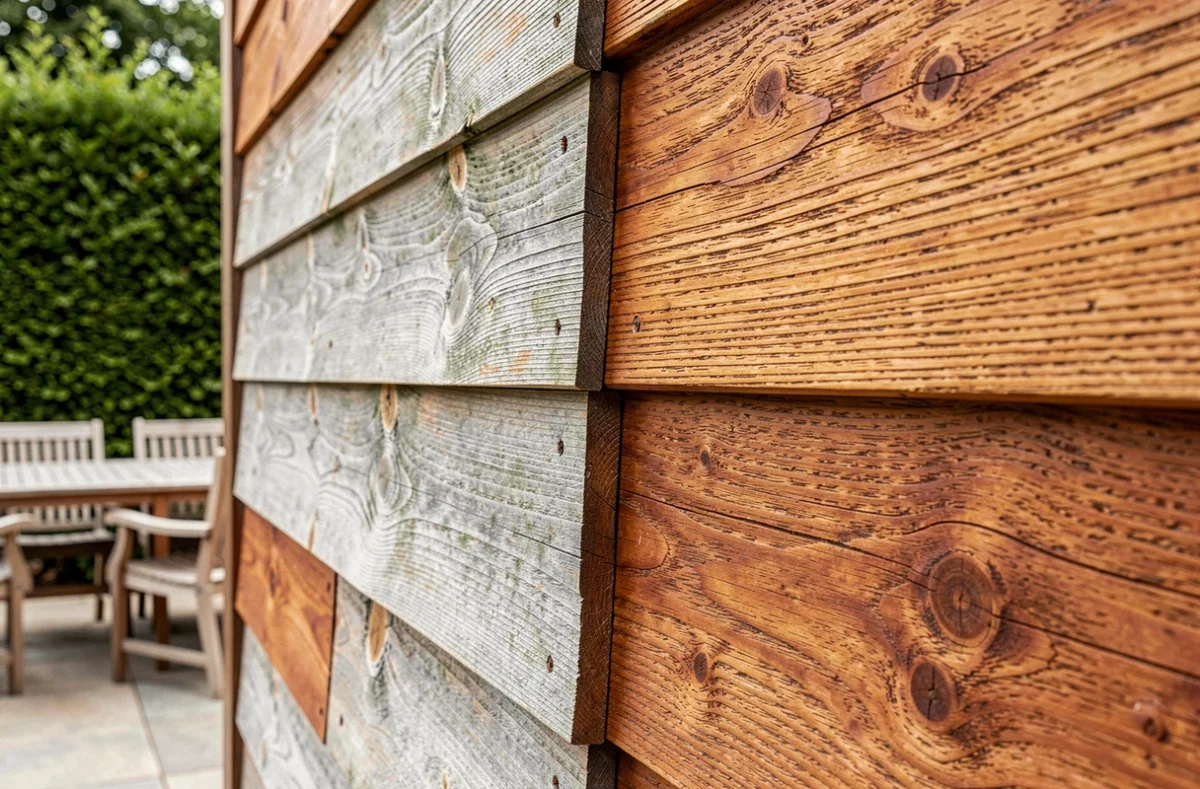
Padauk presents a vivid red color, almost coral, in its fresh state. Under UV exposure, this hue evolves into a silver-gray. The phenomenon is natural and common to most untreated exotic woods, but it poses a specific problem in cladding: exposure differences on the same facade create areas that gray at different rates.
A wall facing directly south will gray much faster than a return facade protected by an eave. For several months, the facade displays a patchwork of shades that does not please all project owners. Field reports vary on this point: some appreciate this evolving patina, while others perceive it as a maintenance defect.
Maintenance and Treatment: Preserve the Red Hue or Accept the Gray
Two approaches coexist:
- Apply a pigmented saturator once or twice a year to slow down graying and maintain the original red hue, which requires a recurring maintenance budget and easy access to the entire surface of the cladding.
- Allow the wood to gray naturally without treatment, accepting the transitional phase of heterogeneous shades. Over time, the entire facade converges towards a homogeneous silver-gray, but the timeframe varies depending on orientation.
- Use a gray remover followed by a saturator to “start over” if the intermediate result is unsatisfactory, a one-time operation that requires careful prior cleaning.
The choice between these options depends as much on the budget as on the aesthetic tolerance of the owner. A padauk cladding without any maintenance remains structurally sound for decades, but its visual appearance goes through phases that not everyone accepts.
Padauk Compared to Other Species and Composite Cladding: Comparison Criteria
Padauk is positioned in the high range of exotic woods for cladding, alongside ipe and cumaru. Its high density and dimensional stability make it a technically suitable material for permanent outdoor use. However, its marked red color and rapid graying clearly distinguish it from more subdued species like red cedar or larch.
In comparison to composite cladding, the criteria differ. Composite does not gray and requires almost no maintenance, but it does not offer the texture or natural aging of solid wood. Padauk remains a choice oriented towards a vibrant aesthetic that evolves over time.
Some criteria to examine before making a decision:
- The CITES traceability of padauk adds a layer of verification absent for local species or composites.
- Machining padauk requires tools suited to its density, which can increase installation costs compared to treated softwoods.
- The dimensional stability of padauk limits expansion gaps between boards, a concrete advantage for the visual consistency of cladding in the long term.
Choosing padauk for exterior cladding is not a default choice. It is a material with real technical qualities, but its adoption requires verifying the regulatory compliance of the facade system, the traceability of the wood, and its own tolerance to graying. A well-installed and well-sourced padauk cladding lasts several decades, provided that these parameters have been addressed before the project begins.